
A pink-tinged urine sample after a sore throat is easy to ignore. In IgA nephropathy, that one episode can be the only early warning of a disease that quietly scars the kidney's filters for years.
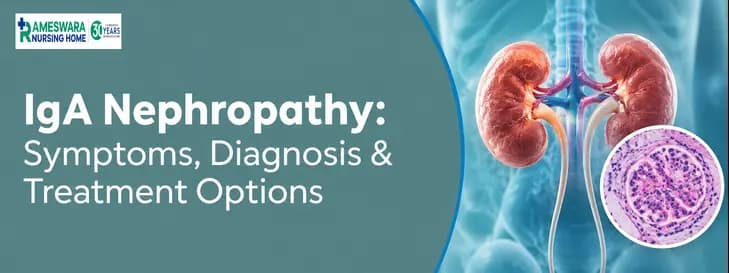
IgA nephropathy is an autoimmune kidney disease where a protein called IgA builds up in your kidney filters, gradually damaging your ability to filter waste. This condition is one of the most common forms of glomerulonephritis (kidney inflammation) worldwide, affecting millions of patients. Early recognition and proper management can slow the disease and preserve your kidney function for years to come.
This guide explains what IgA nephropathy symptoms look like in daily life, how a kidney biopsy confirms the diagnosis, and what changed in treatment after the 2025 KDIGO guideline.
IgA Nephropathy at a Glance
- What it is: an autoimmune kidney disease where IgA antibody clumps lodge in the glomeruli (kidney filters) and cause inflammation and scarring.
- Typical signs: tea- or cola-coloured urine after a cold or sore throat, foamy urine, swelling, high blood pressure. Many people have no symptoms at first
- Diagnosis: urine and blood tests raise suspicion, but only a kidney biopsy confirms it.
- Treatment: no cure yet, but KDIGO 2025 recommends supportive care and IgAN-specific therapy together, aiming for protein loss below 0.5 g/day.
What Is IgA Nephropathy (Berger's Disease)?
IgA nephropathy, also called Berger's disease, develops when immunoglobulin A antibodies are deposited in the kidneys, triggering inflammation and scarring of the nephrons. Researchers describe a "four-hit" process: the body makes abnormal galactose-deficient IgA1, produces antibodies against it, forms immune complexes, and those complexes settle in the glomerulus.
The exact cause is unknown. Genes and environment both appear to play a part, and for many people the first signs show up after a cold, sore throat or other respiratory infection. IgAN is different from IgA vasculitis, which also involves skin, joints and gut.
IgA Nephropathy Symptoms: What Patients Notice (and Miss)
| Stage | What you may notice | What to do |
|---|---|---|
| Silent | Nothing. Microscopic blood or protein turns up on a routine urine test. | Repeat the test and ask for a protein-creatinine ratio. |
| Active | Pink, brown or cola-coloured urine during or soon after a throat or chest infection; foamy urine. | See a doctor within days, even if the colour clears. |
| Progressing | Swelling in legs, feet or ankles; raised blood pressure. | Book a nephrology consultation and ask about a biopsy. |
| Advanced | Fatigue, nausea, headaches, poor sleep as kidney function falls. | Seek urgent specialist care. |
Why blood in urine after a throat infection needs a test
Visible blood that starts during or soon after an infection is a classic IgAN pattern (NKF). Unlike a urinary infection, it is often painless and has no burning. If the colour clears, many patients assume the problem is gone and never return. Our guide to blood in urine without pain explains the other causes your doctor will rule out.
Who Is at Risk for IgA Nephropathy?
IgA nephropathy can develop in anyone, but certain groups face higher risk. Men are diagnosed more often than women, and the disease typically appears in people aged 16 to 35, though it can occur at any age. Patients of East Asian, Middle Eastern, and Mediterranean descent report higher incidence rates, suggesting a genetic component. Previous or concurrent respiratory infections, particularly sore throat and sinusitis, have been linked to IgA nephropathy onset in some patients.
Familial cases are rare but documented, meaning if one family member has IgA nephropathy, others may need monitoring. Patients with celiac disease, HIV infection, or chronic liver disease face increased risk. Environmental factors such as smoking and certain medications may worsen the disease once it develops. If you belong to a higher-risk group or have noticed unexplained kidney-related symptoms, discussing screening with a nephrologist is wise even without a confirmed diagnosis.
How IgA Nephropathy Is Diagnosed
No validated blood or urine biomarker can diagnose IgAN today, so confirmation comes from a kidney biopsy. The work-up usually follows this order:
| Test | What it shows | Why it matters |
|---|---|---|
| Urine routine and microscopy | Red cells, protein | First clue of glomerular bleeding |
| Urine protein-creatinine ratio or 24-hour protein | Protein loss in g/day | KDIGO suggests biopsy above 0.5 g/day |
| Serum creatinine and eGFR | Filtering capacity | Baseline for tracking. See normal GFR by age |
| Kidney biopsy with immunofluorescence | IgA deposits and scarring | The only definitive test |
| MEST-C score and IgAN Prediction Tool | Risk of progression | Guides how aggressively to treat |
| Liver, infection and autoimmune screening | Secondary IgA deposition | Rules out other causes before labelling primary IgAN |
When is a biopsy advised?
KDIGO advises biopsy in suspected IgAN when proteinuria exceeds 0.5 g/day. A needle retrieves a small tissue sample that shows IgA deposits, how much damage exists, and likely future course. A practical tip: ask the lab whether direct immunofluorescence is performed.


Reading your biopsy report: the MEST-C score
-M: mesangial hypercellularity
- E: endocapillary hypercellularity
- S: segmental glomerulosclerosis
- T: interstitial fibrosis and tubular atrophy
- C: crescents
Treatment and Management Strategies
There is no cure for IgA nephropathy, but several evidence-based treatments slow disease progression and protect kidney function. The first-line approach involves managing blood pressure, usually with medications called ACE inhibitors or ARBs (angiotensin receptor blockers), which reduce proteinuria, the loss of protein in urine, and ease stress on remaining healthy kidney tissue. Staying hydrated, limiting salt intake, and controlling other risk factors like cholesterol are essential lifestyle changes.
For patients with more aggressive disease or rapid kidney function decline, immunosuppressive medications such as corticosteroids, mycophenolate mofetil, or azathioprine may be prescribed to calm immune system overactivity. Fish oil supplements rich in omega-3 fatty acids show modest benefits in some studies, though evidence remains mixed. Regular monitoring through blood work and urine tests every 3 to 6 months helps your nephrologist track your progress and adjust treatment as needed. If kidney function declines to end-stage renal disease, dialysis or kidney transplantation may become necessary. Your doctor will discuss which approach suits your case based on your age, overall health, and disease progression rate.
Common Mistakes That Delay IgAN Care
- Treating pink urine as a one-off because it cleared in two days.
- Waiting for pain, since IgAN is usually painless.
- Skipping the protein-creatinine ratio and relying on a dipstick alone.
- Delaying biopsy because of fear, then presenting with advanced scarring.
- Stopping medicines once protein falls; KDIGO frames IgAN as a lifelong condition
IgA Nephropathy Care at Rameswara Nursing Home, Kolkata
Rameswara Nursing Home is a NABH-accredited multi-specialty hospital at P-155 C.I.T. Scheme VII-M, Ultadanga, with over 35 years of service and 85 doctors across 17 specialties. For a condition like IgAN, where care spans urine tests, a biopsy decision, medicines and years of monitoring, several of those services sit under one roof.
| What IgAN patients need | What Rameswara Nursing Home provides |
|---|---|
| Specialist consultation | Urology & Nephro and Nephrology specialties, with 11 consultants listed under Urology & Nephro in the [doctor directory](doctor directory) |
| Urine, blood and imaging tests | In-house pathology, radiology and cardiology on the diagnostics page |
| Complications and emergencies | 24/7 emergency, ICU and ICCU, operation theatres with ITU/HDU backup |
| Admission comfort | General, semi-private and private wards; 50+ beds |
| Payment clarity | Cashless support with 22 insurers and TPAs shown on the site, a billing desk for pre-authorisation, and a published tariff |
Because a biopsy decision depends on proteinuria, eGFR and blood pressure, bring your last three urine reports, creatinine values and current medicines to the first visit. Our team can then explain which tests are needed and how the diagnostic route would work for your case.
Talk to the Rameswara Nursing Home team about your reports and next steps.
Conclusion
IgA nephropathy rewards early attention. A single episode of blood in the urine, a repeat report showing protein, or new swelling is enough reason to see a nephrologist. Confirm the diagnosis with a biopsy, set clear targets for protein loss and eGFR, and start supportive care and disease-specific therapy together as KDIGO 2025 advises. With regular monitoring, many patients protect their kidney function for decades. If you have an abnormal urine report or a new diagnosis, the nephrology and urology team at Rameswara Nursing Home can review your reports and plan the next step.
Medical Disclaimer This article is for general education and does not replace advice from a qualified doctor. IgA nephropathy needs individual assessment, including a kidney biopsy. Do not start, stop or change any medicine without consulting your nephrologist. In an emergency, go to the nearest hospital