
Kidney stones are common enough that most people know someone who's had one. Yet the vast majority of those stones are managed with hydration, medication, ESWL, or a quick ureteroscopy.
Laparoscopic kidney stone surgery is a different, more targeted procedure, one reserved for stones that are unusually large, oddly shaped, or sitting in a kidney with an anatomical complication that rules out the simpler options.
This guide is written specifically for that smaller, more complicated group of patients, people who've already been told ESWL or PCNL won't be enough, or who are trying to understand why their urologist mentioned "laparoscopic" instead of the more commonly discussed procedures.
We'll walk through exactly what the surgery involves, who genuinely needs it, what recovery looks like day by day, what it costs in India, and where a hospital like Rameswara Nursing Home fits into that decision..
What is Laparoscopic Kidney Stone Surgery
Laparoscopic kidney stone surgery is a minimally invasive surgical technique used to remove stones that cannot be treated with less invasive methods like shock wave therapy or ureteroscopy.
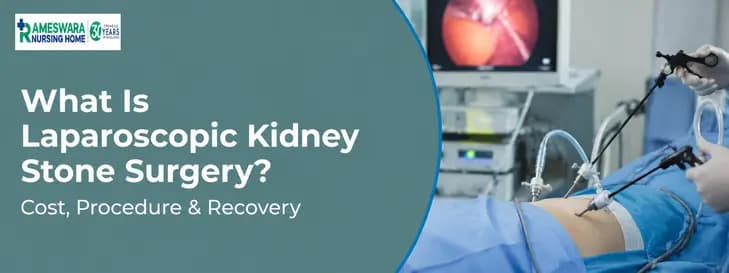
The procedure involves using a thin, illuminated tube called a laparoscope, which allows the surgeon to see inside the kidney and surrounding area through a monitor. Instead of making one large cut, the surgeon makes two or three small incisions, usually no more than half an inch each.
This approach is sometimes called percutaneous nephrolithotomy or PCNL when performed laparoscopically. It is particularly useful for very large stones, stones in unusual positions, or cases where other treatments have failed.
The procedure is performed under general anaesthesia, meaning you will be asleep throughout. Many patients choose this option because it offers a middle ground between non-invasive treatments and traditional open surgery, balancing effectiveness with a gentler approach to healing.
Who Actually Needs Laparoscopic Kidney Stone Surgery?
This is the question most patients are really asking when they search this term, and it's worth answering precisely rather than generically. Based on published urology literature, laparoscopic pyelolithotomy is typically indicated for:
-
Large or staghorn stones, where the stone fills most of the renal pelvis and branches into the calyces, making a single-session PCNL less reliable.
-
Kidney stones combined with a ureteropelvic junction obstruction (UPJO), a narrowing where the renal pelvis meets the ureter. This combination shows up in roughly 1 in 5 laparoscopic pyelolithotomy cases, since the obstruction can be corrected in the same operation.
-
Stones in an ectopic or pelvic kidney, where the kidney's unusual position makes percutaneous access difficult or unsafe.
-
A large overall stone burden in a patient who is a poor candidate for PCNL, for example, due to bleeding risk, since laparoscopy is associated with lower blood loss in comparative studies.
-
Cases where ESWL or PCNL has already failed to clear the stone, or repeat sessions are expected to be needed.
If none of the above applies to your case, it's worth asking your urologist directly whether URS or PCNL might achieve the same result with a shorter recovery, a good specialist will welcome that question rather than default to one procedure.
Also Read: Can Kidney Stones Pass on Their Own: When to Seek Treatment
How the Procedure Works Step by Step
Understanding what actually happens on the table helps most patients feel less anxious about the word "surgery." Here's the typical sequence:
1. Anesthesia and positioning: The patient is placed under general anesthesia and positioned on their side (lateral decubitus) so the surgeon can access the flank.
2. Port placement: A small camera port is placed, usually through or near the umbilicus, followed by two or three additional ports for instruments.
3. Accessing the renal pelvis: The surgeon dissects down to the kidney and opens the renal pelvis directly over the stone.
4. Stone extraction: The stone is removed, ideally in one piece, and sent for composition analysis, a step that matters for preventing recurrence.
5. Stent placement and closure: A DJ (double-J) stent is usually placed to keep urine draining while the pelvis heals, and the incision is closed in layers.
The full operation generally takes between two and three hours depending on stone complexity, and if there's a concurrent UPJO, the surgeon will also reconstruct that narrowed segment in the same sitting.
Laparoscopic Kidney Stone Surgery Cost in India (2026)
Laparoscopic kidney stone surgery in India typically costs between ₹70,000 and ₹1.5 lakh, compared to several times that amount for the equivalent procedure in the US, UK, or Gulf countries.
That range is wide because several variables genuinely change the bill:
| What Changes the Cost | Why It Matters |
|---|---|
| Stone size and complexity | A staghorn stone with UPJO correction takes longer OT time and more resources than a single-pelvis stone. |
| Hospital type and city | Metro hospitals with newer laparoscopic towers and ICU backup tend to price slightly higher. |
| Length of hospital stay | Extra days for observation add room and nursing charges. |
| Pre-op diagnostics | CT urography, blood work, and anesthesia fitness tests are usually billed separately unless bundled into a package. |
| Surgeon and anesthetist experience | More experienced laparoscopic surgeons often have shorter, more predictable operative times, which can offset higher consultation fees. |
Managing Pain and Returning to Normal Life
Pain management is crucial to a smooth recovery. Your surgeon will prescribe appropriate pain relief, typically paracetamol, ibuprofen, or mild opioids for the first few days.
Take these regularly as directed rather than waiting until pain becomes severe. Ice packs applied to the incision area (wrapped in a cloth) can also provide relief. Within the first week, many patients find they need less medication as healing progresses. Constipation is a common side effect of pain medications and surgery itself; your doctor may recommend a stool softener or mild laxative.
Stay active but avoid strenuous exercise, this balance helps prevent stiffness while protecting healing tissues. Wear an abdominal support band if recommended; it can ease discomfort during movement. Return to normal activities gradually.
Light exercise like walking is beneficial, but wait at least 4 to 6 weeks before resuming gym workouts, jogging, or heavy lifting. Listen to your body; if an activity causes sharp pain or discomfort, stop and rest. Most people feel substantially back to normal by 6 to 8 weeks, though complete healing continues for several months.


Potential Risks, Possible Complications and When to Call Your Doctor
No surgery is risk-free, and a page that only lists benefits isn't giving you the full picture. Reported risks of laparoscopic kidney stone surgery include:
- Bleeding requiring transfusion (uncommon, and generally lower than with PCNL in comparative studies)
- Urine leakage from the repair site, usually managed conservatively with stent drainage
- Infection or fever post-surgery
- Incomplete stone clearance requiring a follow-up procedure such as ESWL for residual fragments
- Rare conversion to open surgery if scarring or anatomy makes the laparoscopic approach unsafe to continue.
Discussing these risks in detail with your surgeon, and understanding their personal case volume for this specific procedure, is a reasonable and expected part of consenting to surgery.
Why Choose Laparoscopic Over Open Surgery
Traditional open surgery for kidney stones involves a larger incision, sometimes 4 to 6 inches, which causes more tissue trauma and a longer recovery. Open surgery may require 4 to 6 weeks hospital stay and 2 to 3 months for full recovery.
Laparoscopic surgery, by contrast, uses tiny incisions and typically allows hospital discharge in 1 to 2 days with full recovery in 4 to 6 weeks. The smaller incisions mean less blood loss, lower infection risk, and less post-operative pain. You can return to work and normal activities much sooner.
Scarring is minimal with laparoscopic approach, important for cosmetic and functional reasons. Laparoscopic surgery is also gentler on the kidneys themselves, reducing the risk of long-term kidney function loss.
Modern laparoscopic instruments and imaging technology allow surgeons to be precise while minimizing collateral damage. Research published in international urology journals confirms that laparoscopic techniques achieve stone-free rates comparable to open surgery with significantly better patient outcomes. For most people with kidney stones suitable for laparoscopic removal, this approach offers the optimal balance of effectiveness, safety, and quality of life during recovery.
Also Read: Kidney Stone Removal: Surgical Options and Recovery Timeline
Why Patients Travel to Rameswara Nursing Home for This Surgery
Most patients researching this surgery aren't looking for a list of hospital amenities, they want to know if someone will actually explain what's happening to their body and why.
That's the piece Rameswara Nursing Home in Ultadanga, Kolkata, tends to get right: before laparoscopic surgery is ever proposed, the urology team reviews imaging with the patient in plain language, where exactly the stone sits, whether there's an obstruction alongside it, and why a keyhole approach makes sense over PCNL or a repeat ESWL session.
For a family travelling in from outside Kolkata, or an NRI patient coordinating a trip around the surgery date, that clarity upfront tends to matter more than any brochure.
Rameswara sees a genuine mix of patients, from West Bengal and the wider Northeast, as well as Gulf-based NRIs who plan the procedure around a visit home. A few practical reasons this works for both groups:
- Written cost estimates after consultation, so international patients can plan travel and leave dates with a real number instead of a rough guess
- Coordination support for patients arranging the trip around family visits, which matters when someone is flying in specifically for the surgery
- Post-operative follow-up by phone or video for patients who return home or abroad before the stent-removal or imaging follow-up is due
- A urology team that treats stone composition analysis and prevention counselling as part of the same visit, not a separate upsell, relevant for patients who won't be back in the city for a routine check-in
None of this replaces a direct conversation with a urologist about your specific scan and symptoms, but it's a reasonable starting point if you're comparing where to get a laparoscopic opinion in eastern India.
Conclusion
Laparoscopic kidney stone surgery isn't something most people with kidney stones will ever need, and that's exactly why it's worth understanding clearly if your case has reached this point. It's a well-studied, evidence-backed option for stones and kidney anatomy that simpler procedures can't safely resolve, with recovery measured in weeks and stone-free outcomes that hold up well in published surgical data.
The most useful next step is a proper imaging review with a urologist who can tell you, specifically, whether this is the right procedure for your stone, not just the most commonly advertised one.
Every kidney stone case is different, and the right procedure depends on your scan, stone size, and overall health. Chat with our care assistant on the Rameswara Nursing Home for quick answers, or to book a consultation with our urology team.
Medical Disclaimer This article is for general informational purposes only and does not constitute medical advice, diagnosis, or treatment. Kidney stone treatment decisions depend on individual imaging, medical history, and clinical judgment. Always consult a qualified urologist to evaluate your specific condition before making any treatment decision.